
Miklos Feher's last smile. Number 29: T-shirt forever retirada
The tragic story of Miklos Feher, the Benfica striker, left an indelible mark on the hearts of fans and became an important part of the club's history.
The last smile of Miklos Feher. Number 29: T-shirt forever retirada
According to Tuttomercatoweb.
Context
Miklos Feher, playing for Benfica, became a symbol of tragedy in football. His career, although short, was marked by significant moments, including important goals and assists that influenced the outcome of matches. Feher left a legacy that will be remembered not only as a tragedy, but also as a reminder of passion and dedication to the game.
Why is this important
The tragic death of Miklos Feher became an important moment in the history of football and left a deep mark in the hearts of Benfica fans. His number 29 has been permanently retired to symbolize respect and remembrance of his contribution to the club. The incident also raises questions about player health and safety on the field.
Key takeaways
- The last smile of Miklos Feher. Number 29: T-shirt forever retirada.
- The tragic story of Miklos Feher, Benfica striker, left an indelible mark in the hearts of fans and became an important part of the club's history.
- L'ultimo sorriso di Miklos Fehrer. Il numero 29: una maglia ritirata per sempre.
Miklos Fehér was born on July 20, 1979 in Tatabanyi, Hungary. There are moments that remain in the memory forever, when time stands still and the sport becomes tragically vulnerable. On January 25, 2004, the world of football lost some of its innocence on the wet turf of the Afonso Henriques stadium. Miklos Fehér, Benfica's Hungarian striker, just 24 years old, collapsed during stoppage time against Vitoria Guimarães. He never got up again.
Feher's evening began with a seat on the bench; coming on as a substitute, he had to break into the opponent's defense. And he lived up to expectations: his perfect pass late in the match allowed Fernand Aguiar to score and give the Eagles a 0-1 lead. Then an episode occurred that fate turned into a tragic icon. In stoppage time, Feher attempted to stop a rival throw-in to protect the lead. Referee Olegario Bencrensa came over and showed him a yellow card. Miklos accepted the sanction with a sad smile, straightened his hair and took a few steps before kneeling down. In the next second, his body will fall back, frozen and lifeless.
The situation became clear in a matter of seconds. His teammate Tomislav Sokota was the first to run to him, raising his head to avoid suffocation. Desperate help from doctors began, while a collective dramatic performance unfolded around: players from both teams clutched their heads, many cried, cameras captured faces of bewilderment in the stands.The reflexes on the pitch lasted for long minutes before he was rushed to the Guimarães hospital. But all efforts were in vain. He was pronounced dead at 11:10 p.m. An autopsy later confirmed the cause: cardiac arrest caused by hypertrophic cardiomyopathy, a congenital heart defect that is as silent as it is deadly in professional athletes.
Portugal and Hungary woke up united in deep mourning. Benfica, the club with which Fejer built his career, has officially announced that the number 29 will be retired forever. Now in the lobby of the Estadio da Luz in Lisbon, a bronze bust has been installed, reminiscent of his proud look, which has become a place of pilgrimage for thousands of fans. Miklos's body rests in Gör, his hometown in Hungary, where the following year after the tragedy the entire Benfica delegation went to present his parents with the Portuguese Champions medal, a title Feher helped win.
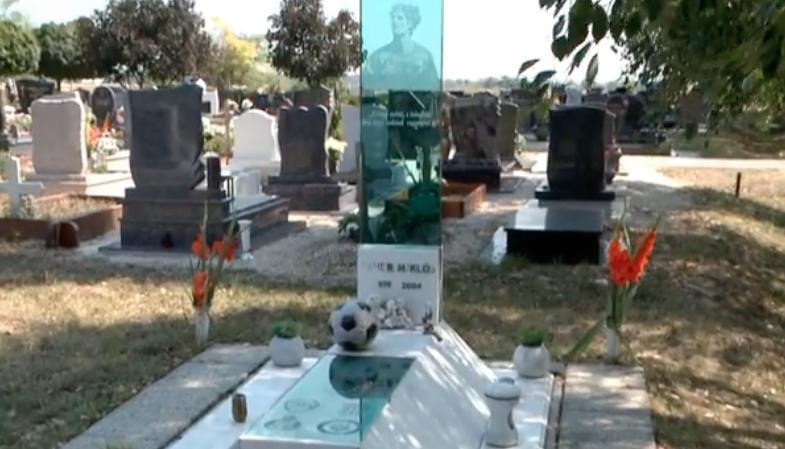
Years later, the story of Miklós Fehér remains a warning about the need for stricter medical checks in professional sports, but above all, it is a memory of a young man whose life was cut short in his prime, and whose last moment was captured in a smile. There are places where football ceases to be a simple game and becomes a sacred memory.At the Estadio da Luz in Lisbon, home of Benfica, time stood still on that dramatic January 25, 2004. The Eagles have since turned the pain of losing Miklos Fehér into an unprecedented monumental and institutional tribute, embedding the Hungarian striker at the very core of their history.
Sanctuary at Porta 18: bust of Soares Branco. The pulsating heart of Fejer's memories lies at Lisbon's Porta 18 stadium. Here, in the high-traffic concourse, fans not only traverse the club's present, but also stand in silent respect before a bronze bust depicting the proud face and gaze of the young striker. This work, commissioned by the club and executed by the famous Portuguese sculptor Soares Branco, was unveiled on January 22, 2005, on the first anniversary of the tragedy. Next to the bronze, which stands on a pedestal with the player's birth and death dates, is a marble book. Embossed on it is an expression that has become a manifesto of mourning for the “Benficas”: “Lembrança. O tempo passa, a saudade fica" (In memory. Time passes, deep melancholy remains).
Theme from the Cosme Damian Museum. Nearby, inside Cosme Damian's modern Benfica Museum, Miklós's history becomes dramatically felt. Preserved as a secular relic in a special display case, is the red jersey number 29 that Fejer wore on the wet Guimarães turf. The fabric still retains visible traces of the dirt from that night, a fragment of reality that touches visitors every day.Next to the form, the museum's multimedia systems show in an endless loop his play, his goals and, inevitably, that final smile cut short by fate, marking the young man's life until its end. Number 29: T-shirt forever retirada.
The most solemn and intangible tribute to the Portuguese club still remains in the dressing room. A few hours after the tragedy, the Benfica management decided to permanently retire the number 29 jersey. In the Eagles' dressing room, this number became taboo: no athlete, from juniors to the first team, would ever be able to have it printed on their backs. An official decree ensuring Feher's sporting immortality. Every January 25, Porta 18 ceases to be a simple passage and turns into an altar. Leaders, captains of all sports sections of the club and thousands of fans gather at the foot of the bust to lay wreaths, scarves and candles. A secular pilgrimage that shows how, years later, the connection between Benfica and its unfortunate champion has never been broken.
What happens next
After the Fejer tragedy, Benfica and other clubs began to take medical protocols and ensuring the health of players more seriously. Clubs are expected to continue to raise awareness of the risks associated with cardiovascular disease in athletes. Feher's memory will live on in the hearts of fans, and his story will serve as a reminder of the fragility of life.
Frequently Asked Questions
When and where did the tragedy with Miklos Feher happen?
The tragedy occurred on January 25, 2004 at the Afonso Henriques stadium during a match against Vitoria Guimarães.
What goal did Miklos Feher score in this match?
Miklos Fehér made the perfect pass that allowed Fernand Aguiar to score and give Benfica a 0-1 lead.
What was the cause of death of Miklos Feher?
The cause of Miklos Fehér's death was cardiac arrest caused by hypertrophic cardiomyopathy.
What impact did Feher's death have on the Benfica team?
The death of Miklos Fehér was a tragic moment in the history of the club and left a deep mark in the memory of players and fans.
What jersey number did Miklos Feher wear?
Miklos Feher played at number 29, which was forever retirada.
Similar articles
- Marco Baroni: “The team is not complete yet, several players are missing”
- Messi: The clash with Yamal in the World Cup final after a photo as a child is
- Spain vs Argentina: Predictions for the 2026 World Cup final
- Forecast: Seattle Sounders vs. Portland Timbers
- Ken Bates: a bright, controversial and significant personality
Similar articles
Similar articles
Similar articles
Related News
All News →
PSG won the UEFA Super Cup, Xavi led
«ПСЖ» выиграл Суперкубок УЕФА, победив «Астон Виллу», Элина Свитолина проиграла Иге Швёнтек, а Кори Гауфф — Елене Рыбакиной в полуфиналах «тысячника» в Торонто, Хави стал главным тренером сборной Нидерландов.

Aston Villa are ready to part with the 19-year-old defender
Астон Вилла планирует продажу молодого защитника Тристона Роу, который проявил себя во время аренды в FC Annecy. Это решение может стать ошибкой, так как игрок уже зарекомендовал себя в профессиональном футболе.
Ryan Cherki: “We will start a different story” after Guardiola
Раян Черки поделился своими впечатлениями после матча Манчестер Сити с Кристал Пэлас, в котором его команда одержала победу со счётом 4:1. Он отметил необходимость улучшить свою игру и взаимодействие с партнёрами.
Aston Villa are in the race for Chelsea striker Nicholas
Астон Вилла ведет активные переговоры с Челси о трансфере Николаса Джексона за 80 миллионов евро, выкуп финансируется за счет продажи Олли Уоткинса в Саудовскую Аравию.